" height="271.9999926478547px" id="EEb7rlRyU" width="823.9999863254119px"/><path d="M 41.234 82.42 C 64.009 82.42 82.469 63.97 82.469 41.21 C 82.469 18.451 64.009 0 41.234 0 C 18.461 0 0 18.451 0 41.21 C 0 63.97 18.461 82.42 41.234 82.42 Z" fill="rgb(20, 232, 155)" height="82.4204655951471px" id="oKwt2AI3_" transform="translate(545.508 14.698)" width="82.46885142513122px"/></g></svg>)
Genetically engineered crops: advances in biotech and regulation.
4 min read
Food production and agriculture are significant contributors to greenhouse gas emissions, accounting for one-quarter of the world’s emissions (13.6 Gt CO₂e per year). Major contributors to these emissions include the conversion of forests, grasslands, and other carbon sinks into cropland, as well as the application of fertilisers that release nitrous oxide (a potent greenhouse gas). Enhancing crop yields to reduce land use change and deforestation, and decreasing the reliance on nitrogen fertilisers are crucial strategies for mitigating these emissions.
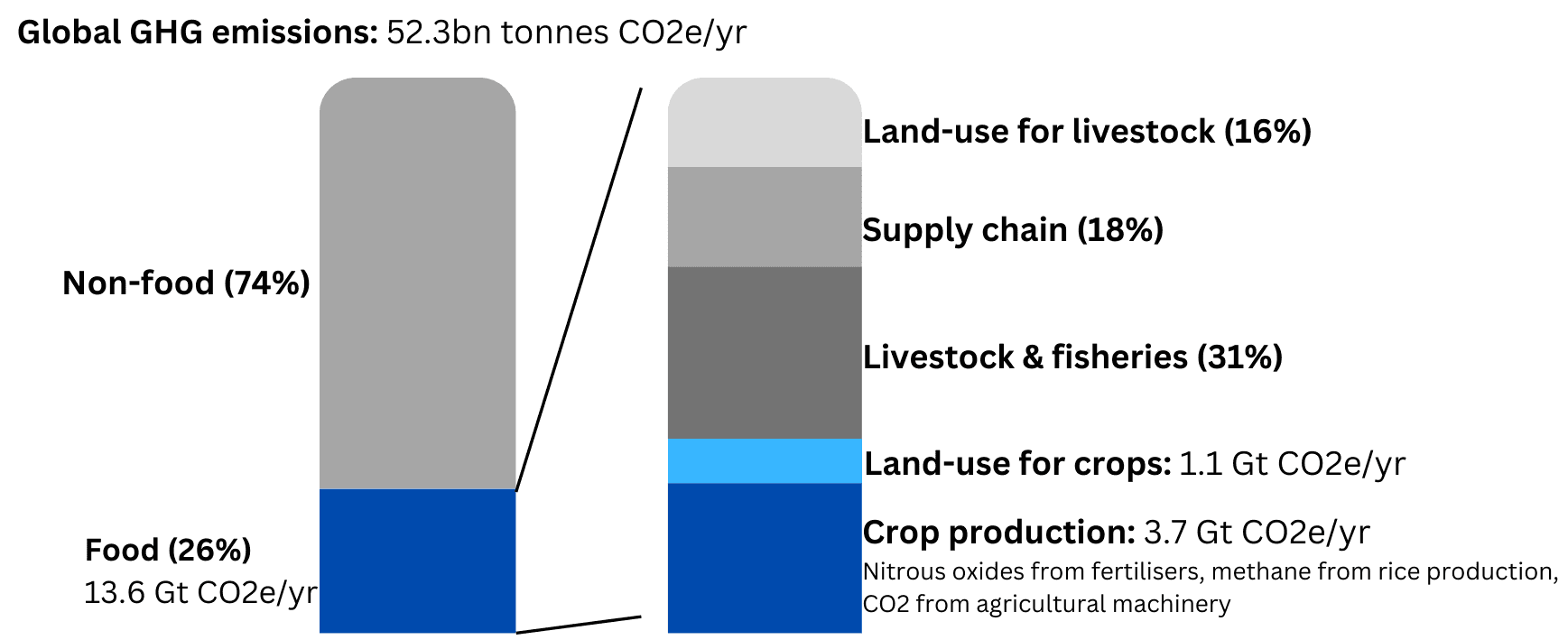
Above: Image adapted from Our World in Data
At ZCC, our focus on Food & Agriculture has led to investments in Climate Crop and NetZeroNitrogen which are at the forefront of reducing the emissions associated with growing crops on a large scale. We are inspired by the potential for impact in this sector, but are also aware of challenges that startups face. One of the challenges is the regulatory landscape for genetically engineered organisms and ZCC's Sarah attended the Hello Tomorrow webinar on ‘Naturally & Genetically Improved Food & Agri Products’ to learn more.
Traits are genetic characteristics of an organism, determined by one or multiple genes and the conditions that result in the expression of those genes. In agriculture, beneficial traits can enhance food quality, boost crop yields, and reduce the need for fertilisers and pesticides. They can also provide drought tolerance and other characteristics that build resilience in a changing climate. Beneficial traits can be introduced into crop plants through traditional selective breeding methods or through advanced methods of genetic engineering.
The goal of plant breeding is to increase genetic diversity and then select the plants with desirable traits. There is a long history of innovation to improve the efficiency of this, from cross breeding and hybrid breeding in the 1920s, mutation breeding in the 1930s, to the more recent development of precision breeding using genetic engineering. Advances in genetics and DNA sequencing led to the first genetic modification techniques, as an efficient way of introducing desired traits into crops, and the first crops classified as GMOs (genetically modified organisms). Even more recent advances in biotechnology gave rise to gene editing (or genome editing), which are more precise techniques for altering the DNA of crops with significant potential to enhance crop innovation.
Genetic modification often involves the insertion of foreign DNA into the crop genome using a plasmid as the vector to carry and transfer the DNA. Transgenic genetic modification involves transferring genes from one species to another, and in cisgenesis the DNA is from a wild relative (crossable with the crop). Although the DNA being transferred is known and precise, the location of insertion into the genome is random and unpredictable, reducing the efficiency of this method to produce crops with the desired traits.
Alternatively, the more modern gene editing techniques use nucleases, of which CRISPR/Cas is the most widely used tool, to make targeted genetic changes at specific locations in the genome without necessarily incorporating foreign DNA. Often these genetic changes are possible through selective breeding, but can be achieved much more rapidly with gene editing. The precision of gene editing enables location-specific alterations, large insertion/deletions (complete genes) or small changes (one or two DNA base-pairs, similar to natural mutations but directed instead of random), and changes to multiple genes in parallel.
The European Union's approach to genetic engineering has traditionally been conservative, treating all methods of genetic alterations uniformly under strict GMO regulations. However, a proposal submitted by the European Commission in July 2023 suggests a reclassification of genetically engineered plants. This reclassification would exempt plants with genetic alterations that could occur naturally or through conventional breeding from GMO regulations, while those with more complex modifications would still need compliance. Although the proposal could take years of review in the European Parliament and is likely to be amended, we think this is a positive sign for encouraging food & ag innovation in Europe and unblocking solutions to low emissions, resilient food production.
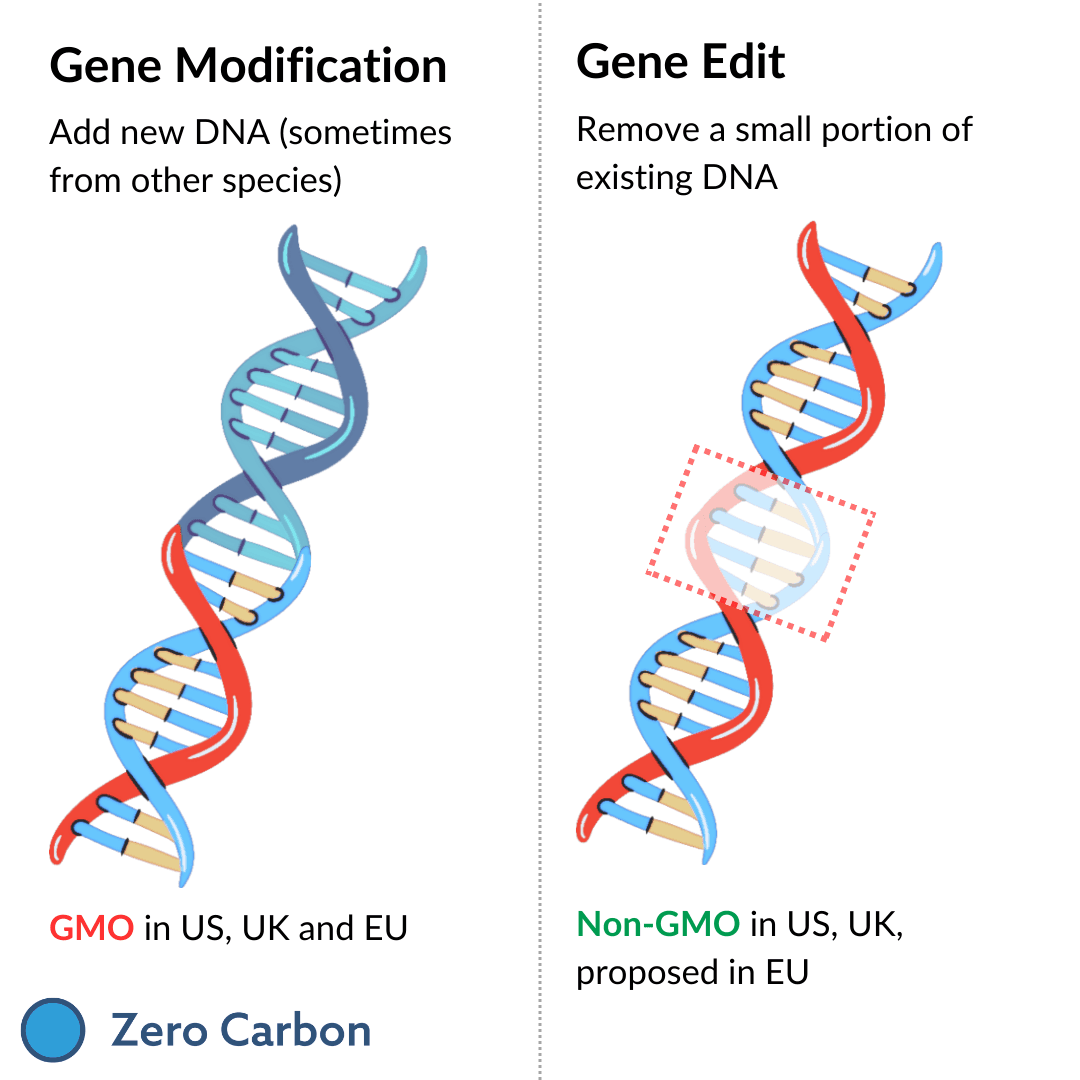
The EU has the most stringent regulations on genetic engineering globally with other regions moving ahead in amending their legislation. The Genetic Technology Act was passed in the UK last year which differentiates Precision Breeding (plants developed through gene editing) from GM (which produces crops containing genetic changes that could not have occurred through traditional breeding). And in North and South American countries, as well as in Japan, India and Australia, specific applications of gene editing are not subject to GMO legislation. Europe is a strong contributor in the agriculture and biotechnology sectors, but the proposed regulatory changes are necessary to stimulate research, startups, and industry in the region. And does the distinction between GMO and gene edited crops go far enough? Genetic engineering is a tool to improve the efficiency of introducing genetic diversity that results in traits for secure food production. Dame Ottoline Leyser suggests that new traits in crops should be assessed equally regardless of the method used to introduce them.
Regulation is important for ensuring that food is safe to eat and has minimal ecological impacts. But it must evolve alongside advancements in biotechnology and our expanding understanding of the outcomes of using these tools. This principle holds true across various sectors, not just in food and agriculture. By fostering safe innovation, we can make significant strides in reducing the carbon footprint of our food systems and enhancing food security.